Post 1: Introduction
Hello and welcome to my first blog post about Monique W. Morris’ novel Pushout, The Criminalization of Black Girls in Schools. This book discusses problems that young Black girls face everyday in school, whether it’s suspension, expulsion, or physical violence.
Morris begins the book with an introduction, highlighting several examples of young Black girls who have been attacked or harassed at school. For instance, a sixteen year old girl in Alabama, Ashlynn Avery, fell asleep reading in her suspension. Instead of waking her up, her teacher threw a book at her head. After being ordered to leave the room, a cop “allegedly slammed her face into a file cabinet and then arrested her,” (Morris, page 3). This is not only a problem of violence, but of clear racism. Nothing should institute a teacher throwing an object at a student’s head. It says in the book after the girl didn't respond, the teacher automatically went to violence. Perhaps this teacher was a violent person, but there could definitely be a racist undertone.
Morris begins the book with an introduction, highlighting several examples of young Black girls who have been attacked or harassed at school. For instance, a sixteen year old girl in Alabama, Ashlynn Avery, fell asleep reading in her suspension. Instead of waking her up, her teacher threw a book at her head. After being ordered to leave the room, a cop “allegedly slammed her face into a file cabinet and then arrested her,” (Morris, page 3). This is not only a problem of violence, but of clear racism. Nothing should institute a teacher throwing an object at a student’s head. It says in the book after the girl didn't respond, the teacher automatically went to violence. Perhaps this teacher was a violent person, but there could definitely be a racist undertone.
 |
| Cover of the book ("Pushout: The Criminalization of Black Girls in Schools.") |
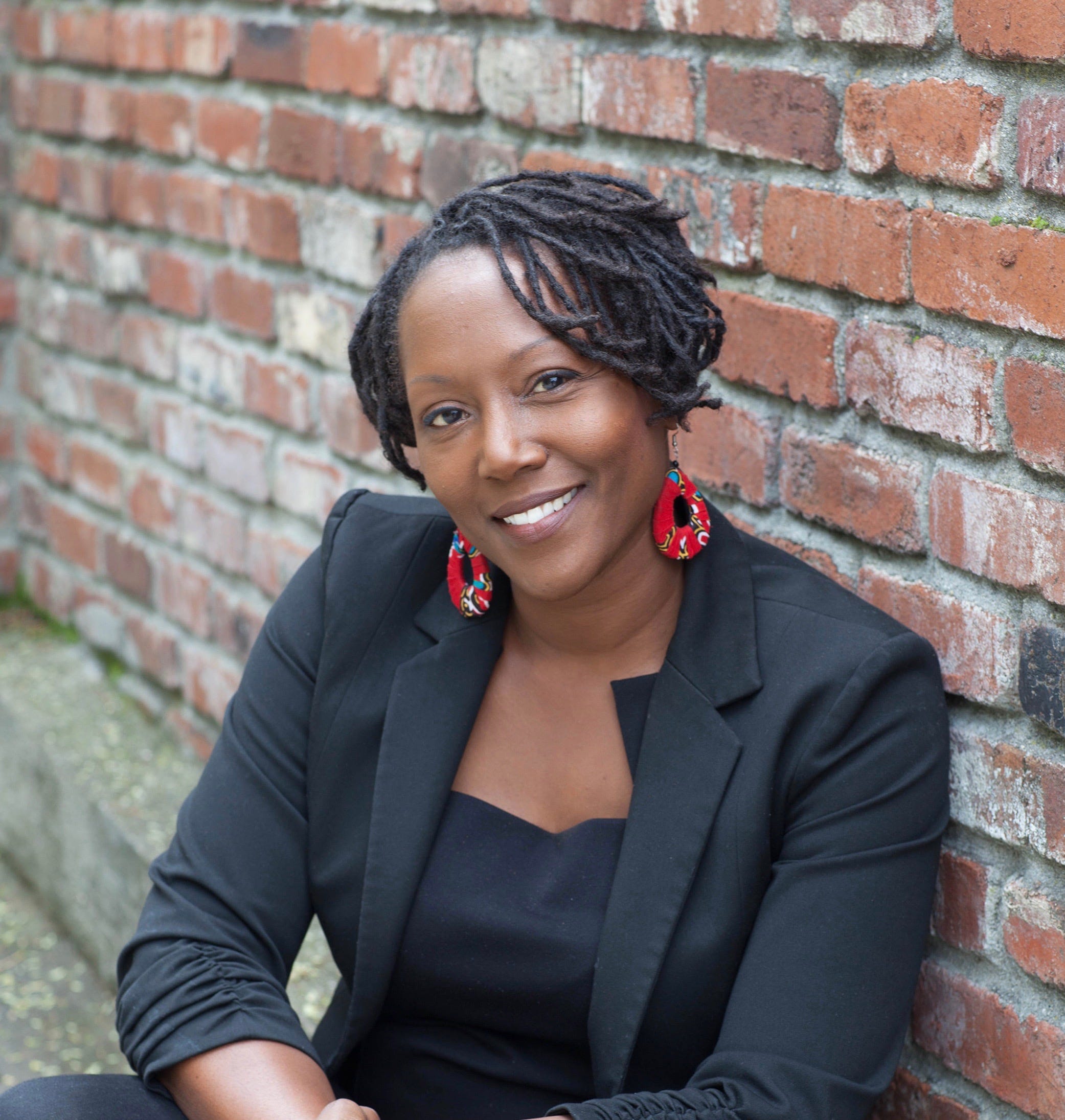 |
| Monique Morris ("As schools prepare to reopen, we must remove cops from campuses to protect Black girls.") |
After the introduction pages in this novel, the first chapter is called "Struggling to Survive." Throughout history, Black women have been dehumanized through slavery, oppression, violence, and objectification. Being a minority, a person of color or a woman, they have gone through "barbarous mistreatment that could only be inflicted upon women," (Morris, page 19).
Black girls get called "ghetto" a lot, and it is a symbol of strength and toughness through their racial and gender oppression. "To 'loud' is a demand to be heard. To have an 'attitude' is to reject a doctrine of invisibility and mistreatment. To be flamboyant, or 'fabulous' is to revise the idea that socioeconomic isolation is equated with not having access to materially desirable things," (Morris, page 19). With every word used against Black women, they have to prove themselves by overcoming and remaking stereotypes.
Nikki Jones, a sociologist and writer, discussed the difference between "good girls" and "bad girls." She said good girls spend their time in church, with their family, or at school. Jones said good girls are not sexually promiscuous, they will grow up to be a lady, and put the needs of her family first (Morris, page 20). If girls don't do these things, they will be labeled as a bad girl or a ghetto girl. "Bad" Black girls are described as girls who smoke, drink, steal, and lie. Even men do all these things as well, they are not held to the same standard that Black girls are.
Morris also talked about "Ghettoized Opportunity." Having access to a good public education is more a race problem than a gender problem. While many white girls have some disadvantages, when it comes to good education, it affects Black girls the most. Having a good education influences your career and your future life. Schools that are low performing and high poverty schools have the highest number of dropouts, which isn't a huge surprise because if the students are underperforming, they are less motivated to finish high school. As a result of dropping out, some Black girls went to prostitution for work. "'I hardly ever see them because they are, like, working all the time...It's better to go to school and get a career, but it's like, if you can get money, like right then and there, then why would I want to go to school for however many years?'" (Morris, page 32). This was said by Destiny, a Black and Latina girl. This thought might go through a lot of Black girls' heads, wondering if there's even a point of finishing high school in a high poverty area, when they could be starting a career making money. However, they could be making more money if they went to school and got a degree, so it's about the opportunities they are given. If they can't pay for college or get a scholarship, how are they supposed to get a high paying job? The unemployment rate of Black women without a high school diploma is 20%, and the rate for Black women with a college degree is only 6%.
Morris gave us a deeper look into these high poverty high schools. The girls she asked said they were chaotic and a lot of fighting, not a good learning space. One girl described that there were cops in the school everyday. "'Like, every single day, all day, cause somebody tried to bring a gun, and somebody tried to do something stupid. I don't know...Sometimes, if you're already like that, and you're already raised up to be around people like that, like, you just get used to it and you don't really care, you know? And then you start doing bad,'" (Morris, page 37). It's upsetting to see that these students are so used to having police officers roam the halls because it's dangerous. No child should have to worry about guns being in their school. Because of the focus on violence, it's harder to focus on the school work.
Thank you for reading my first blog post! I'm looking forward to diving deeper into this book.
Works Cited
"As schools prepare to reopen, we must remove cops from campuses to protect Black girls." USA Today, 7 July 2020, www.usatoday.com/story/opinion/policing/2020/07/07/black-girls-need-protection-school-criminalization-cops-campus/5356613002/. Accessed 12 Mar. 2021.
Morris, Monique W. Pushout: The Criminalization of Black Girls in Schools. New York City, New Press, 2016.
"Pushout: The Criminalization of Black Girls in Schools." The New Press, thenewpress.com/books/pushout. Accessed 12 Mar. 2021.

Hi Riley!
ReplyDeleteLoved reading this post, and interesting to hear about a different book. I loved how you wrote, "This is not only a problem of violence, but of clear racism." I admire the fact that you got right to the point. So many people avoid calling things what they really are. Do you think that is because they are in denial of their racist tendencies? Interesting to see our privilege as white girls, and how different our lives are. I enjoyed reading!
Hi Sara, I really think it's important to straight out call racism what it is. And I do think that people are afraid of calling it out because of their own racist tendencies. There are so many small comments and micro aggressions that are said to Black people, so when it becomes regular, some people people not see a problem with it. Also, it really is interesting to see our privilege as white girls, and though we as girls go through some struggle and face issues, it is not nearly as much as Black girls.
DeleteI really enjoyed reading your first blog post! I completely agree that Black women are constantly having to defend themselves and overcome stereotypes thrown at them. I think this contributes to them having to change the way they act in order to avoid being generalized into a stereotype. This book sounds really intriguing and I will be interested to read your future blog posts!
ReplyDeleteHi Riley! I really enjoyed reading about your book! I like how the book majorly focuses on specifically black women, and shows their perspective on how they are forced to navigate through life. It is so eye opening to read about the violence they experience, especially Ashlynn Avery's story. The trauma that these girls must be faced with after dealing with these situations is horrid and devastating. Nevertheless, I am looking forward to reading your next post! - Natalie
ReplyDeleteHi Riley!
ReplyDeleteI really enjoyed reading your first blog post! I think you touched on excellent ideas and I have to say I think I might read your book now. I don't think I would have been interested, but from reading your blog I got sucked into this story. I liked the part where you mentioned words that have been used against women of color, and how they have to prove themselves by overcoming and remaking stereotypes. I also found it fascinating when you were comparing traits of "good girls" vs "bad girls", and even though some men do all these "bad" things as well, they are not held to the same standard that Black girls are. Do you have any predictions for the rest of your book? What has been the most eye-opening part so far?
-Cailey :)
It is really interesting and upsetting that men and women are held at different standards, and that women are criticized and stereotyped for things that some men do frequently. As for predictions at this point in reading, I was definitely expecting more stories and interviews about girls who had faced these harsh stereotypes. An eye-opening part that I read was about a girl in detention. She said she didn't have any homework, so she was simply sitting there. The teacher watching over the detention was upset that she didn't have any work out, so instead of asking her to do homework, she threw a stapler at her head. This was so shocking to read, because of how extreme the teacher took it. There was no reason for this, other than linking a young black girl to violence.
DeleteHi Riley, I think your book is taking an interesting perspective on race. You spoke a decent amount about the words and ideas used against both younger and older Black women in this post, along with other factors. Through your reading, have you seen that other people's opinions have impacted the girl's feelings about themselves? People in general often take other's words to heart, so being a teenager and experiencing racism would, I imagine, impact their self-image.
ReplyDeleteHey Tessa,
DeleteI have definitely seen examples in the book about these young girls taking words to heart. When you hear the same insults and stereotypes about you, your family, and friends all the time, you start to believe it. Like I talked about a little in the beginning of my post, Black girls get called "ghetto" all the time, even if their behavior doesn't match with the definition of ghetto. There was a part of my book where young girls were calling themselves ghetto because they heard it all the time, but they were just 10 or 11 years old, so it's sad to see that at that age they were being stereotyped by others.
Hi Riley!
ReplyDeleteI liked your first blog post! I think you shared some really good ideas on what you have thought about the book so far! As you continue reading I am eager to see what you think about the book. I liked you were able compare the "good" and "bad" girls as well as your thoughts on the girls defending themselves. I hope you enjoyed the first section of the book! I sure did! What has been the most surprising thing in the book so far for you?
- Annie H
Hi Annie,
DeleteYes, it was interesting to read about the "bad" vs "good" girls as society and Black girls themselves see it. One of the most surprising stories in this book for me was the fact that some girls started dropping out of school and turning to "working," which was another word for prostitution and exploitation at the age of twelve. It was shocking to read what those girls were going through at that age, and then to look at my life at the age and see the huge difference.
I'm glad that you commented on the different standards for men and women; do you think there are different standards for black women/girls and white women/girls when it comes to their behaviors and actions? How does that add to the point Morris is making?
ReplyDeleteHi Ms. LaClair,
DeleteI definitely think there are standards for Black vs White women in society. I think in a lot of ways, race outweighs gender when it comes to stereotypes and inequality. Black women are viewed often as angry, ghetto, uncivilized, and physically threatening. In a certain situation, if a Black woman were to stand up for herself, she might be seen as aggressive and mad, but if a White woman were to stand up for herself in the same way, she might be respected a little more because of the fact that she is white, which is the point Morris is trying to make throughout the book.